Overview
This account sketches the life of the founder of the Milwaukee branch of the Kortsch family in America, with a digression on some distant but interesting cousins.
Information on the lives and work of Ferdinand’s son, Paul, Sr, and his grandson, Paul Jr.–MMK’s father–is also available. MMK and each of her siblings has their own biographical sketch and set of pictures: Paul (‘Pat’), Alice, Mom, Ellen, Jack, Gerry, and Kevin
More information on MMK’s family and pictures can be seen in ‘Kortsch Family: Earliest Pictures’ and Mom’s Photo Album.
Ferdinand and Wilhelmine Meissner Kortsch
The first of the Kortsch family in Milwaukee was Johann Wilhelm Ferdinand Kortsch, who mercifully went by Ferdinand or ‘Fred’. Born in in 1826 in Magdeburg, Prussia, he emigrated with his first wife and two sons in 1856 and made his way to Milwaukee, where he continued in his trade of cigar maker and later manufacturer.
Ferdinand married his first wife, Wilhelmine (‘Minna’) Meissner (b. 1828, Bavaria), in 1849, with whom he had four sons:
- Leopold (b. 1853 in Prussia-d. 1909),
- Paul (b. 1854 in Prussia-d. 1921)–(Paul, Sr.),
- Johann (b. January 1856 in Berlin-d. January 1856 in Berlin, living only 13 days,
- Maximilian (‘Max’ or ‘Maso’ as a child) (b. 1857 in Milwaukee- d. 1923).
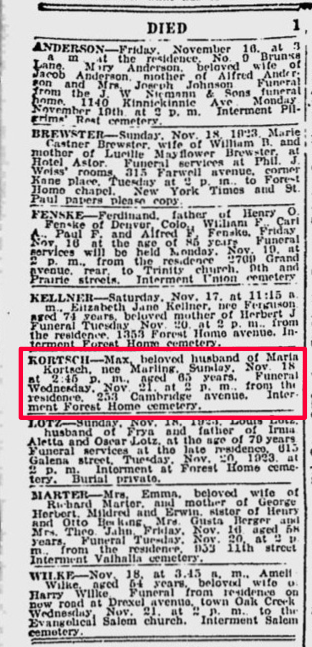

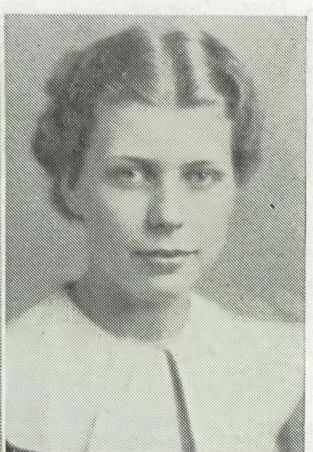
[To Be Discovered: why on Max’s 1870 birth registration (not his birth certificate, which is completed soon after a birth) (left) Ferdinand said Max was born in Prussia instead of Wisconsin. In that same 1870 birth registry (see left) Leopold and Paul have the correct birthplace as Prussia, although Ferdinand does get their birth years wrong, taking a year off each of their ages. Condense to note?]
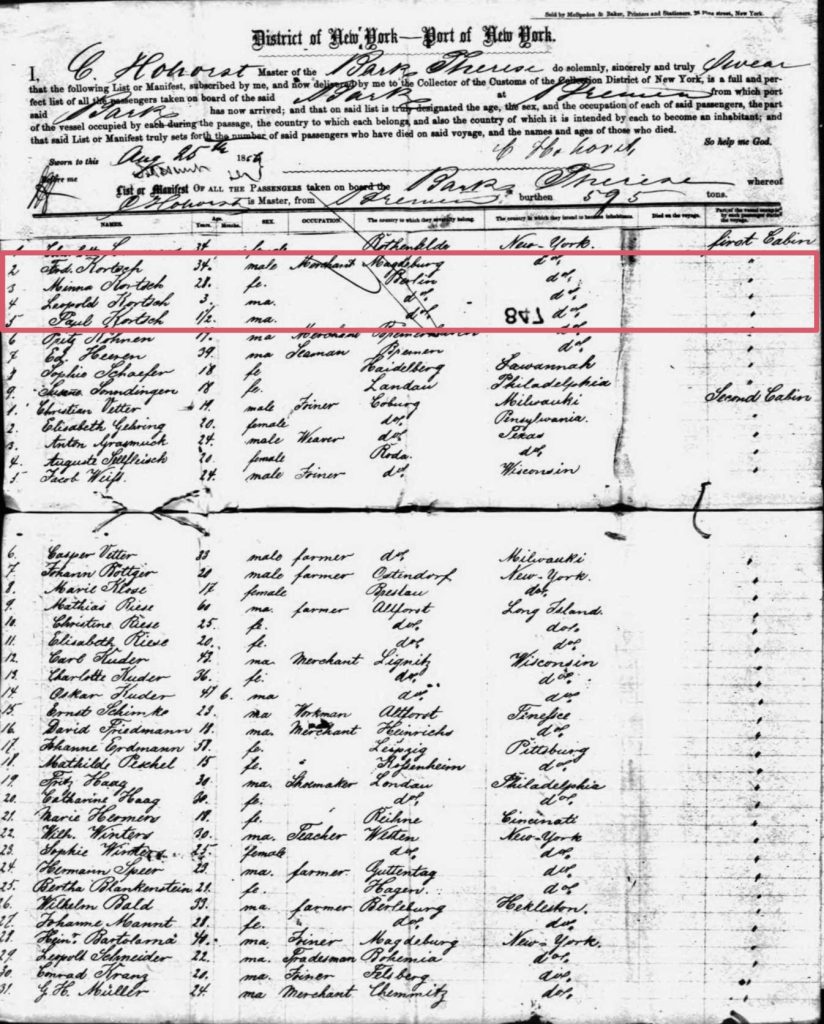
And for occupation the wonderfully clear demonstration of phonetic misspelling, the apt “segarmaker” (writing a word the way it sounds). Leopold and Paul were indisputably born in Prussia. Their names and their parents’ are recorded in the Therese arrival register in 1856.]
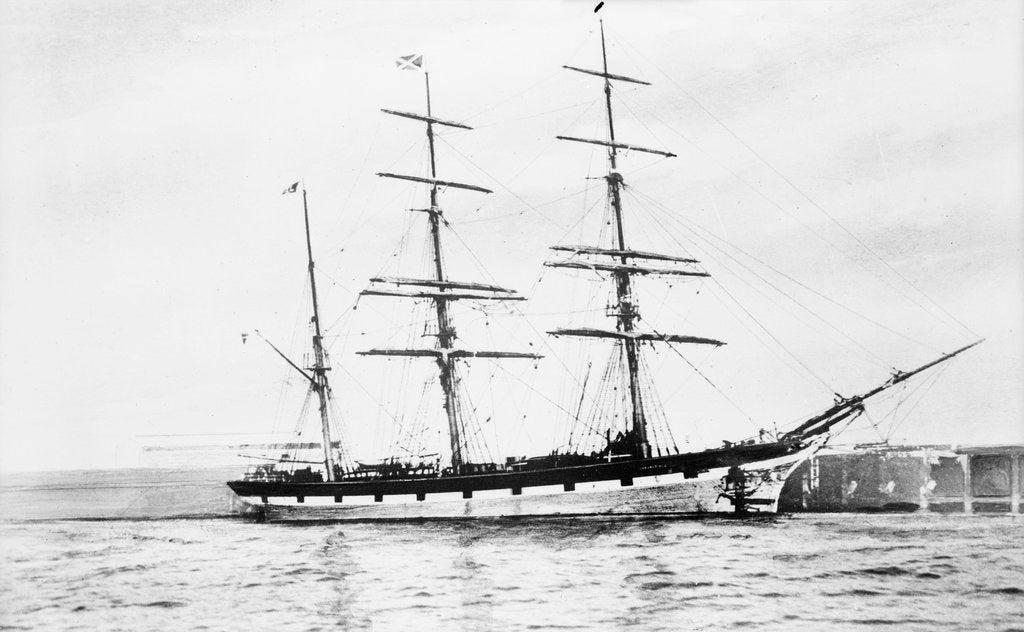
On their trip to America the Kortsch family travelled comfortably in a first class cabin, arriving at New York aboard the small, three-masted barque Therese. Their arrival record is below, so too an example of a barque.
Wilhelmine died in 1862, after which Ferdinand married (take a deep breath!) Katharina Babetta Eugenie Luise Wilhelmina Frickinger (b. 1827, Ansbach, Bavaria) the following year. She, also mercifully, went by Eugenie.
Ferdinand and Eugenie Frickinger Bissing
Eugenie’s First Husband: Melchior Bissing
Eugenie’s (or Eugenia. Records vary) first husband was Melchior Bissing (1822-1862), a butcher also Bavarian-born, whom she married in 1854 and with whom she inherited three stepchildren.
Melchior’s first wife, the mother of the three children, was Agenia (b. 1828, unmarried name not known). They married in 1854 and by 1860 were living in Milwaukee’s ninth ward, which was as heavily Germanic as the fourth was Irish. (FN: T
The core of the ninth ward was the Riverwest area and included Kilbourn Town, the western part of Downtown, and the western part of Old Milwaukee). Their three children were:
- Theodor (1854-1948), [FN/ASIDE/”To Be Discovered Note: Theodor–at some point time Anglicized his first name by adding an ‘e’ at the end. Later in life he also changed the spelling of his last name to ‘Bessing’ for reasons unknown. Some question if b. in 1854 or 1855. We’ll use 1854, it being on his gravestone and the date most often cited in the historical record. His 1870 birth registration (different from his birth certificate by not being recorded soon after the birth). Moved to Los Angeles between 1885 and 1888 and remained there the rest of his life.
- Add his Turner Club picture
- Nanny (b. 1857, who lived only five years), and
- Alwine (b. 1858)–frequently spelled ‘Alvine’ or ‘Alvina’, about whose later life there’s more to say further down.
Also in the household were
- Amalia (b. 1846 in Saxony) working as a servant (age 14) for the family (misidentified in 1860 Census as Amalia Bissing)
- Johann Torn, age 17 (b. 1843 also a butcher. Johann may have been apprenticed to Melchior and lived with him, a not unusual arrangement for apprentices.
Just when Agenia died isn’t known, sometime between 1860 and 1862, when Melchior himself died. In that same, sad year, Melchior’s daughter, Nanny, died at the age of five. Whether father and daughter died together or separately couldn’t be determined.
[FN/ASIDE: One might wonder if he died in the Civil War, but there’s no record of his serving as a soldier.
Upon his death he left an estate of property and personal belongings worth $2500, now about $98,000–or $78,000. ???? Double check. Did–can’t track it down—Delete
Eugenie and the Kortsches
Eugenie found herself in an unpromising situation upon the death of her husband, one not uncommon for women at the time: a young widow (age 36) with three young, dependent children, and no means of support.
Eugenie did not remain a widow long, just ten weeks long, in fact. She and Ferdinand married on January 13, 1863. Mr. Bissing had died on October 29, 1862.
Ferdinand and Eugenie had no children of their own. With five surviving children in the blended family they may not have felt any need to add another chair at the table.
Their marriage seems to have been harmonious. It lasted until Ferdinand’s death 37 years later.
The harmony did not outlive Ferdinand for very long. After his death the Kortsches and the Bissings almost immediately began quarreling over the disposition and apportioning of their father’s estate (described below with more details in the entry on Paul Sr).
By 1880 all of the the Kortsch and Bissing children had left the Kortsch home in Greendale except daughter Alwine Bissing Busjaeger and her daughter, Frida Busjaeger, age 2. Alwine had married Louis Busjaeger in 1876 when she was 18.
Eugenie Kortsch, Solo–And A Rift In The Family
Ferdinand died on January 1, 1900. Eugenie lived another seventeen years.

His death certificate (left) lists the cause of death as chronic encephalitis with marasmus as a secondary contributor. Encephalitis is a swelling of the brain often caused by an infection. Symptoms include joint pain, headaches, sensitivity to light and sound, seizures, and pronounced lethargy, the last being why the illness is popularly known as “sleeping sickness.”
Marasmus is essentially severe malnutrition, particularly deficiencies of protein and calories. The affected person loses muscle and fat as the body cannibalizes itself to find what protein and calories it can, leading to a cadaverous appearance.

After Ferdinand’s death Eugenie sold his cigar manufacturing business and their family home, which was the spark for the ensuing split between Eugenie and her three Kortsch stepchildren.
There is no evidence that tells us how the Kortsch and Bissing children got along with each other during the almost 40 years Ferdinand and Eugenie lived together. The one document we do have comes near the end of Eugenie’s life and indicates not at all well.
In her will (on left) she not only cut out the three Kortsch children from any inheritance at all from the sale of the business and house, she does not even acknowledge their existence. Eugenie pointedly left everything to “my two and only children,” Theodor and Alwine Bissing. Eugenie, possibly remembering her own bleak prospects after her first husband died, may have wanted the entirety of Ferdinand’s estate to ensure their futures and her own.
In 1910, 82-year old Eugenie Kortsch was still living, alone, in Milwaukee, after which she disappears from the records there. However, a year later a Eugenia Kortsch takes up residence in Hannibal, Missouri, where she dies in 1917.
At the advanced age of 82 Eugenie decided to leave her home of 60 years and relocate to Hannibal to live with daughter Alwine in her declining years. To what extent the tension with her Kortsch stepchildren motivated her to move isn’t known but it must have been a consideration.
Eugenie (1827-1917) is buried in the same Hannibal cemetery as “Alvina” (1858-1947) and Louis Busjaeger (1854-1936), her daughter and son-in-law. She lived to be 89, a long life then and now.
More details about this quarrel are in Paul Kortsch Sr.
???Milwaukee to Hannibal to Los Angeles: Ferdinand’s Stepdaughter, Alwine Bissing Busjaeger (Move Both Digressions to Their Own Pages, Add Links Back and Forth)
THE GREAT MIGRATION WEST: TWO STORIES A Short Digression on Some Minor But Interesting Players
Alwine married Louis Busjaeger in 1876. Louis is a shadowy figure in Alwine’s history. He somehow managed to avoid being listed in public records for virtually his entire life. No birth certificate, no death certificate, and in between, no listing in any census. He steps into the light only three times: his marriage to Alwine in 1876, his appointment as executor of his mother-in-law’s estate, and finally as a name on a gravestone (1936).
Alwine seems to have followed the lead of her husband, appearing just four times in public records: her birth in 1859 and her marriage to Louis in 1876, but for the entire length of her marriage she too disappears from the records, only to reappear after he dies in 1936, living in Los Angeles until her death there in 1947.
Alwine’s story seems to go like this.
- She marries Louis Busjaeger, lives with him in Hannibal most of her life, their daughter Frida being born there in 1878. Louis dies in 1936. Then, in the same year, Alwine, by then 78, moves to Los Angeles, presumably to be closer to daughter Frida (about whom more in a minute). Frida and her daughter Elsa had moved there sometime between 1920 and 1930, when she is listed as married and the head of the household, designations for a woman often signaling she is living separately or divorced from her spouse.
- If Alwine had hoped to live with Frida in Los Angeles, it did not come to pass. In 1940 Alwine is living in the home of Elsa Scott and her son, Walter (yes, really), in Pasadena, where she had been since 1936. Then 81, she is listed as the mother in the family, either a mistake by the census taker or the result of being misled by Elsa and Alwine for their own purposes. Frida, on the other hand, 62 years old and widowed, was living alone in Los Angeles proper. (The two Elsas are not the same person– different birth years and birthplaces.)


- Alwine died in 1947 in Los Angeles of malnutrition and starvation caused by a duodenal ulcer (far left). A slow, difficult way to die, the primary symptoms are nausea and vomiting after eating, leading to an understandable loss of interest in food. She died in a nursing home/hospice where she had been resident for a month.
- The “informant” on Alwine’s death certificate, the person who provides the personal details of the decedent to the coroner, is not her daughter Frida or her granddaughter Elsa Moore, but her landlady, Elsa Scott. Frida and Elsa did not do the job customarily done by a family member.
- Alwine was cremated and her ashes transported back to the same Hannibal cemetery where her mother was buried, and interred with her husband, Louis Busjaeger. Time has faded the inscription on their gravestone (left) but it’s still legible.
A Depression Era Story: Ferdinand’s Granddaughter, Frida Busjaeger Moore, and Great-Granddaughter, Elsa Moore Rooke
Alwine’s daughter Frida married the charmingly named Noble Edgar Moore (1877-?) in 1906, their child Elsa arriving in 1907.
- Noble may have been married before Frida. In 1900 he reports that he is 22 and a widower. The age is right, and the widower status is possible, but in 1910 he says that his marriage to Frida is his first. Either he was suppressing the earlier marriage in front of Frida or the 1900 census taker made a mistake.
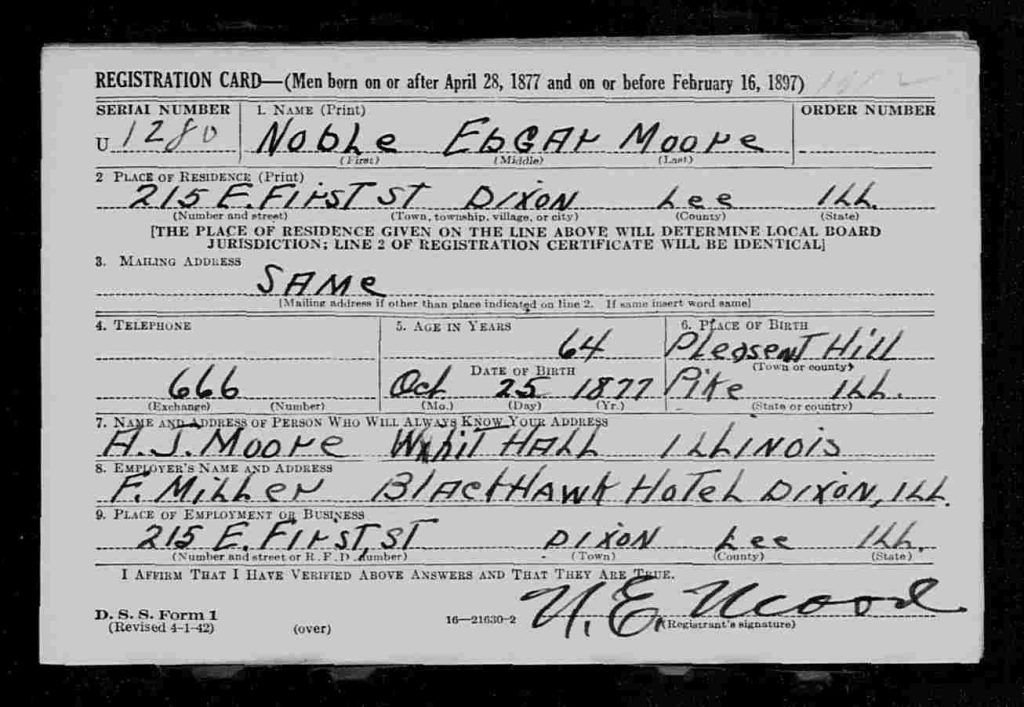
- Noble and family were living in Springfield, Missouri, in 1910, where he worked as a “druggist” (drugstore clerk most likely), and later in Rock Island, Illinois, where he found a job first as a baker in 1918 (in his draft registration below), then as a cashier in a café (1920).
- By 1930 Noble has disappeared and Frida, now the head of the household, is living in Los Angeles with Elsa, where they remain for the rest of their lives. Why they moved so far from their Midwestern roots isn’t known.
- See the file: “Frida Busjaeger Great Migration West”–(two populations of migrants: Okies(Grapes) and refugees from the Great Depression (Locust) Similar crushing of dreams.
- If Frida’s self-description of herself as being married in 1930 is truthful, Noble was still alive, albeit whereabouts unknown. In 1940, she lists herself as widowed but then ten years later as divorced. She clearly wasn’t telling the truth on one of those occasions. Noble can’t be traced, and no divorce decree or death certificate for him could be found. We don’t know what the truth is here.
- Noble might have died between 1930 and 1940. Or, in those turbulent, bleakest first years of the Depression, he may have taken to the road in search of a job, something many other men were forced to do. He may have died on the road or he may taken the opportunity created by the social disarray of the times to follow the road to a new life elsewhere–we just don’t know. Noble’s passage through life is stubbornly invisible.

- Frida and Alwine may not have been close, if that’s a fair reading of the hints, but Frida was close to her daughter, Elsa. Frida in 1950 was living in the same apartment building in Alhambra as Elsa and her family, just a few doors away. Elsa had married Charles W. Rooke in 1935. Their two two daughters were born in 1937 and 1941.
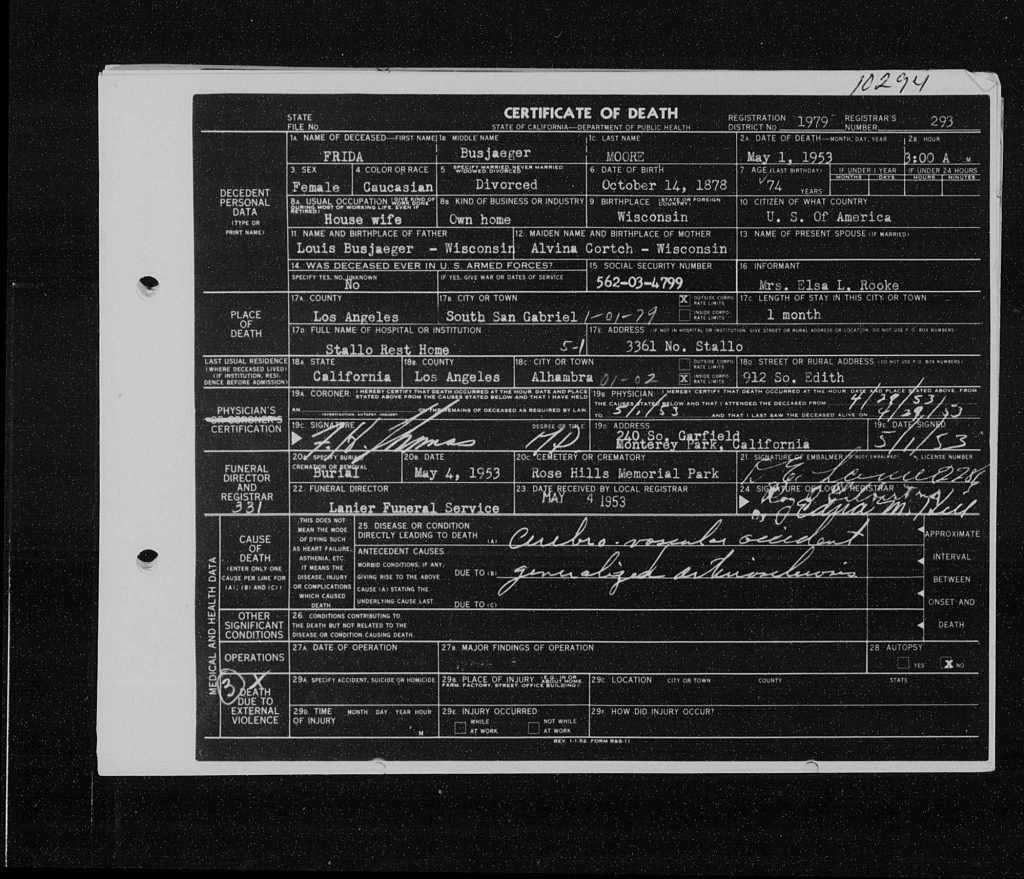
Frida (1878-1953) died just six years after her mother, a stroke caused by generalized arteriosclerosis (below). Elsa died in 1996 (1907-1996) and is buried with Charles (1905-1989).