
Inspection Cards of the Guiney Sisters, And Their Ship
Background
The number of people coming to America during the mid-19th and early 20th centuries has been described as the largest mass migration in human history. To accommodate these numbers a screening system was put in place that was far from the chaotic scramble people imagine it to have been.
Although certainly imperfect in its execution and limited by its medical and diagnostic knowledge, the process was rigorous for its time.
The immigration cards of Margaret, Alice, and Ellen, three of the children of John J. and Margaret Maune Guiney. The “Ganey” misspelling of their name by the immigration officer gives us an idea of how it was pronounced with an Irish accent. More on their family name and biographical information can be seen in the post on the Guiney Family.

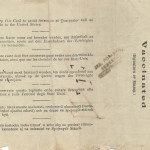

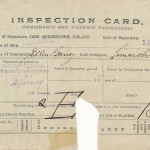

In her letter to Mom (left), Aunt Marcella mentions she has an inspection card in the name of “Biddie Ganey” (Bridget), Nana’s younger sister by two years (b. 1892) but didn’t include it. Nana’s isn’t included, either. Aunt Marcella says she may have given it to her earlier and it’s now lost.
The Immigration Process, Late 19th Century
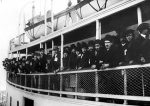

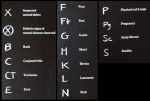
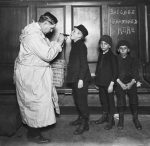

- The first inspection usually began in the hometown of the potential immigrant when they went to buy a ticket from an agent of the steamship line. These agents screened each person for physical or mental infirmities before permitting the ticket to be bought. They had an incentive to be diligent. They could lose their jobs if they allowed someone from one of the prohibited classes to land at Ellis Island,.
- The immigrants were next inspected at the port of embarkation by the ship’s doctor before being allowed to board. Here, again, there was a financial incentive to be conscientious in the examination. If someone with a communicable disease were allowed to board, the steamship company could be fined $100 ($3800 today).
- During the voyage each immigrant was given an inspection card with name, birthplace and year, and other identifying information, like the examples at top.
- This examination came when the ship entered the New York harbor and inspectors boarded while at sea to check each passenger for quarantinable diseases like cholera, smallpox, typhus, yellow fever, and the like.
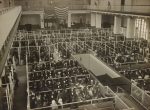
- Upon disembarking there was still another inspection, this time by two physicians who examined each immigrant, the first looking for one set of medical conditions and the second, another set.
- Finally, the person was questioned by an immigration agent who matched the answers given with the information on the ship’s manifest sheet.
- Only then did the immigrants complete the intake process. If admitted, they had their money converted into US currency and were taken to one of the train stations to buy tickets to their destination.
The process was designed to be efficient, cautious, and humane. Successful immigrants spent an average of three to five hours at Ellis Island and the other ports of entry. If someone was turned away after arrival, they could appeal the decision to a Board of Special Inquiry for a reevaluation. Further appeals were possible, laddering up to the Secretary of Commerce and Labor, whose decision was final. While the appeals were taking place, the deportation order was stayed until a final decision was rendered.
The Ship
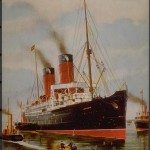
The ship they sailed aboard, Cunard’s RMS Lucania, was a modern, well appointed vessel capable of carrying 2000 passengers and renowned for having the finest first-class accommodations then afloat, though the nine Guineys would have seen little of it from their vantage point in steerage. Launched in 1893, its first voyage set a westward crossing speed record of five days and twelve hours, a distinction it held for five years.



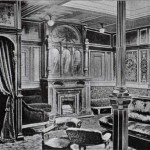
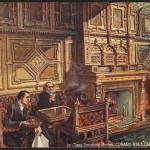
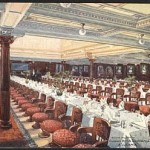

Its impressive achievements notwithstanding, Cunard decided to scrap the ship after only 16 years, deeming it too expensive to repair after a fire caused extensive damage while at dock in Liverpool.