Life On the USS Effingham
Dad was fortunate as a wartime sailor in that his life was not jeopardized on a ship that endured repeated battles.
A Haskell-class attack troop transport, the USS Effingham was completed late in the war and played only a minor role, serving for just three missions, only one of them in combat. The Effingham didn’t lose a single crewman in its war service. An estimable life even if a short one.


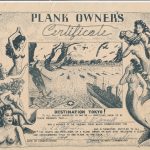
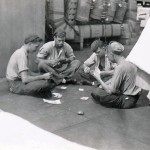
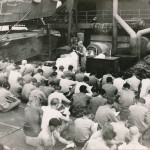


The Effingham’s life as a warship lasted only nine months, from November 1944 to August 1945, though it served another nine months, until the following May, when it was decommissioned and scrapped.
The one battle it was in, the invasion of Okinawa (April to June 1945), is noted by historians for its ferocity and the decisive moment that finally convinced Japanese military leaders the war was all but over. The Effingham’s role at Okinawa was to support troops rather than engage in combat, off-loading battle-hardened 1st Division Marines who had survived some of the bloodiest fighting in the South Pacific and then reinforcing them with supplies.
In another stroke of luck, the ship stayed at Okinawa only six days before being ordered to return to San Francisco for reoutfitting. By the time it arrived back at the island on August 12, the battle was over and war’s end only three days away.
The ship was then assigned to carry the 1st Marines to Jinsen in western Korea and to northern China, where they assisted in those countries’ occupations. (Take a look at Dad’s copy of “A Marine’s Guide to North China”) a booklet given to the Marines to teach them about China and Chinese nationals,
It then served as a transport bringing soldiers back to the US as part of the Magic Carpet demobilization operation.
The USS Serpens and USS Indianapolis
The Effingham did not manage to escape the war’s bloodshed entirely. Dad was lastingly affected by the destruction of the USS Serpens, crewed by Coast Guard personnel, which exploded at a Guadalcanal base on January 29, 1945, while loading depth charges on board. With the exception of two very lucky men aboard and eight who happened to be ashore (Dad’s annotation isn’t quite right, as a subsequent inquiry showed), all of the ship’s 198 man complement were killed, as well as 57 Army stevedores who were working on the ship at the time. It is still the single worst catastrophe in Coast Guard history. The Effingham participated in the futile search and rescue operation.
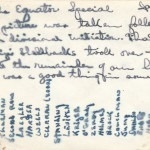
Fifty years later Dad described his best and worst moments aboard the Effingham for a 1995 newsletter (below), the worst being the explosion of the Serpens. The full newsletter can be seen in the ‘USS Effingham Reunions‘ post.

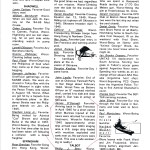
The sinking of the USS Indianapolis on June 29, 1945, also made a lasting impression on him. The ship was torpedoed by a Japanese submarine after delivering the first atomic bomb to the air base at Tinian, losing 300 men in the immediate explosions and another 600 from exposure, dehydration, and shark attacks during four days of floating in the water before rescue. Only 300 men survived.
In Jaws, Robert Shaw, playing a survivor of the Indianapolis, describes in a somewhat fictionalized but mesmerizing monologue what it might have been like waiting for days to be attacked by a shark.
Dad saved a news article about the Indianapolis (below and in the ‘USS Effingham Reunion‘ post).
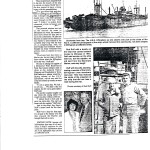
Also below is a 1999 news article about the Effingham.