
Introduction
Pictures of Pat as a child can be seen below and in Mom’s Photo Album. Only one picture of Pat as an adult is in the archive, taken in 1985 by Mom while on a trip to St. Petersburg, looking very much like his father.
Life, Eloping, And Two Marriages in Three Days
Pat is the Kortsch child who most seems to have gone his own way, literally and figuratively. Instead of staying in Milwaukee like all his brothers and sisters, he moved to Orlando, FL sometime between 1932, when he was working as a timekeeper in Milwaukee and 1935, when he was in Orlando working as an accountant in private practice.
He made some other unconventional choices, too. The newspaper clipping announces his surprise marriage to Helen M. Hayes (not the actor) following a Northwestern-Minnesota football game in Chicago on October 29, 1936.
Helen Margaret Hayes was born in 1916 and grew up in Fox Point. She was an undergraduate vagabond, starting at Milwaukee-Downer College, transferring to Lindenwood College in Missouri for the 1935-1936 year, and then to Northwestern for 1936-1937.


The clipping says Pat had been a student at Northwestern, whether as an undergrad or law school student isn’t spelled out. Further, it says Pat was then an attorney working for Milwaukee Coke and Gas, the same company his father, Grandpa Kortsch, worked as an executive.
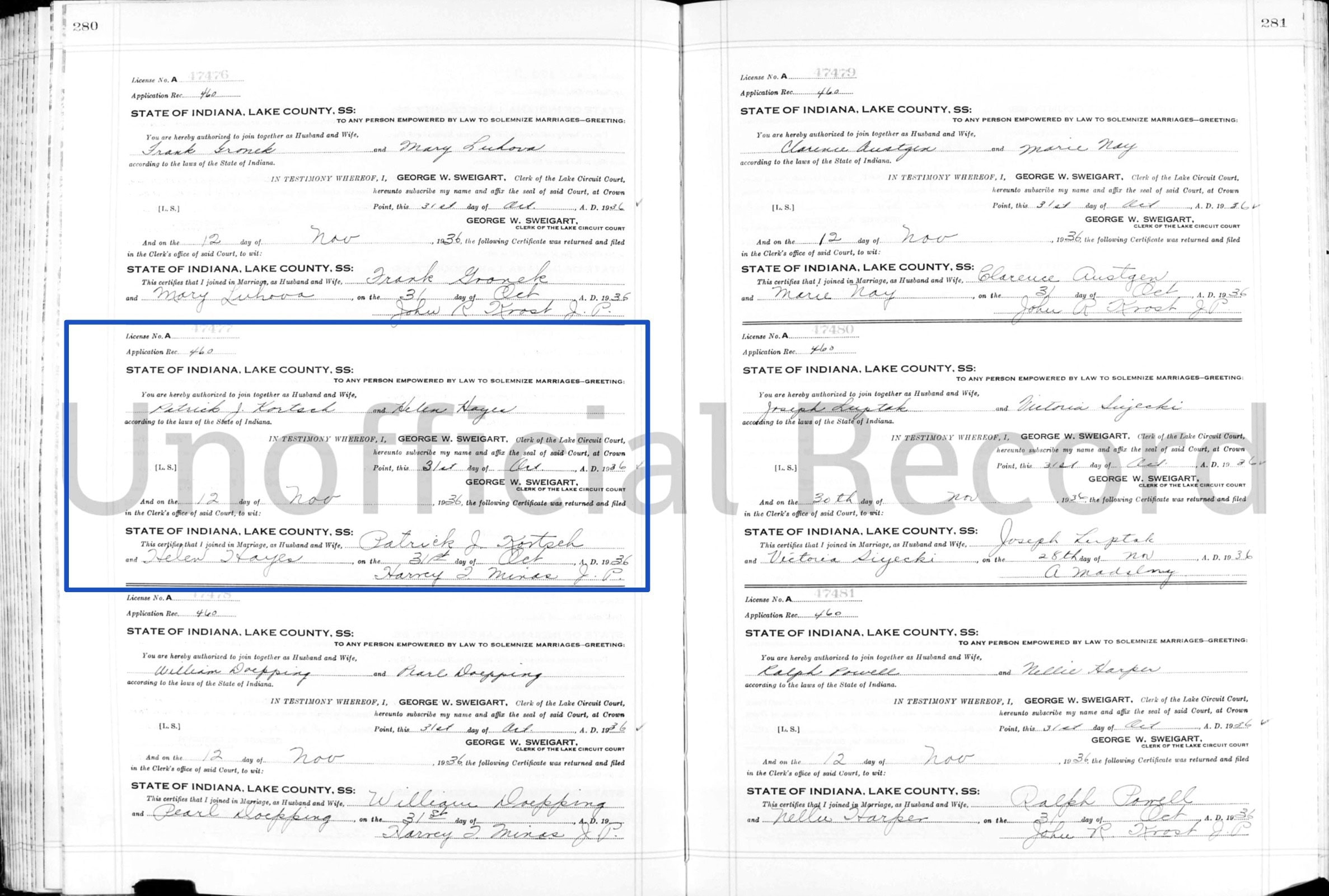
The football marriage appears to have been a theatrical performance for their friends rather than a legal joining of two people. On the Monday after the game Pat and Helen drove to nearby Crown Point, Indiana* where they could be officially married by a Justice of the Peace without the inconvenience of the week waiting period required by Illinois. It was a startling departure from the usual propriety of the Kortsch family.
Northwestern ground out a win against Minnesota, 6 to 3, a happy augury but not one fulfilled by later events.
* Crown Point in the early decades of the twentieth century had well earned a tawdry reputation as a marriage mill , the place to go for Chicago couples, often propelled by too much alcohol, who wished to sidestep the week-long waiting period mandated by Illinois law.The light poles in the town square were plastered with advertisements for Justices of the Peace, and all the couple needed to do was choose one and pay a fee that varied from $5 to $20, depending on the hour they chose to disturb the Justice. So frequent were these drunken unions that a wedding in Crown Point became known as a “gin marriage.” Crown Point had already been made notorious a couple of years earlier for an equally dubious distinction as the place where John Dillinger was briefly jailed in its supposedly escape-proof prison. Less than two months after his arrival, Dillinger engineered a swaggering escape, entrenching his place in the American imagination as a romantic outlaw striking back not only against the banks that had become symbols of an indifferent economic order but also against the police who enforced a social structure perceived as rigged against ordinary people. Dillinger’s freedom was short-lived. A few months after his escape, he met his end outside a Chicago movie theater, gunned down by a swarm of FBI agents and local police. His violent death only served to solidify his legend as a figure of rebellion, a martyr of sorts, fighting against an indifferent social order and then being killed by the agents of that order. Crown Point stood as a symbol of both impulsive love and defiance against authority, both of which were held to be disgraceful by conventional moralists but both have also been enduring themes in American movies and literature. |
A Perplexing Series of Events
This sequence of events seems straightforward but it raises some baffling questions:
- in 1932 Pat is working as a timekeeper in Milwaukee, possibly before starting law school in that fall.
- in 1935 he’s in Orlando, doing what isn’t given.
- in 1936 he’s working as a junior clerk at Milwaukee Coke and Gas.
- in 1936 he marries Helen Hayes, telling the newspaper he graduated from Northwestern and was working as an attorney at Milwaukee Coke and Gas.
- in 1940 he’s an accountant living in Orlando.
- in April 1940 he tells the census taker he was living in Orlando. Six months later he fills out a draft registration form attesting to his living in Milwaukee (below).
- In 1942 Pat is working in Chicago for the Arthur D. Anderson accounting firm.
Here are some of the questions raised by the chronology still to be answered:
- Pat could have spent 1932-1935 completing a law degree. Why, then, move to Orlando immediately after finishing, then move back soon after to marry and begin work as an attorney at Milwaukee Coke and Gas?
- Why was he working in 1936 as a junior clerk at Milwaukee Coke if he had a law degree?
- When and where did he meet Helen Hayes, who began at Northwestern in the same semester she married Pat in 1936?
Something else the chronology shows us is Pat shifting his career from being a lawyer to being an accountant. After law school and possibly practicing at Milwaukee Coke for a couple of years his entire job history was accounting in both private and public functions. He worked many years for the city of St. Petersburg in building, building code compliance, and accounting.


Pat may have been more successful than his father in World War I in being granted a deferment. Despite telling the 1950 census taker he had served in the military, there is no record of his being inducted or actively serving. The only military connection discovered was his draft registration card (above).
The Lindenwood College Bulletin (above) mentions the birth of their daughter, Helenah Ann, on September 2, 1939. For some reason, a few months later they changed the little girl’s name to ‘Deborah Ann’.
Their marriage foundered after a few years, and whatever happened occurred abruptly. In 1940 the couple was living at 4187 N. Montreal St. in Milwaukee, still married but separated. The census taker noted that Pat’s actual residence was in Orlando, while Helen and her seven month old daughter had returned to St. Charles, Missouri, where Lindenwood College is located.
Their divorce was finalized in May 1942. In the same month Pat corrected his draft registration to show that he was then living in Chicago and working at the Arthur D. Anderson Company.
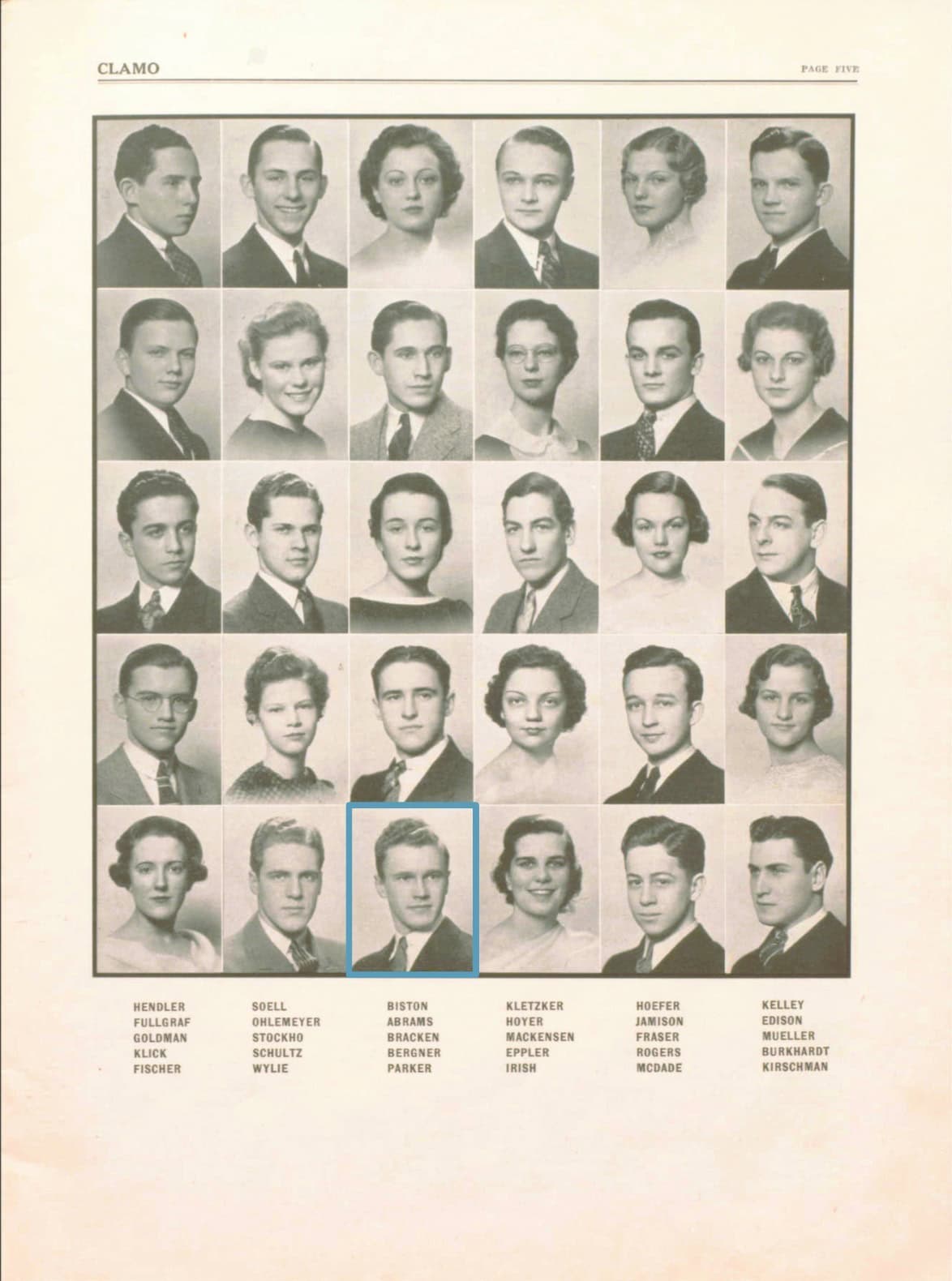
Helen married Gilbert Schuyler Parker, then living in St. Louis, in 1946. St. Charles is only 30 miles NW of St. Louis, so even if we don’t know how they met it is easily imagined.
Mr. Parker did serve in WWII, enlisting in 1940 and was assigned to Battery A, FAM N6
Helen and Gilbert, then, like Pat, an accountant, remained together in St. Louis and raised two sons and a daughter in addition to Helen’s daughter Deborah. Gilbert later moved from accounting to working as a fire prevention engineer, the same profession his father followed. Mr. Parker died in 1965, Helen Kortsch Parker in 1978.
Pat’s Daughter, Deborah
Pat’s daughter Deborah (1939-2020) married first Alan Kieninger in 1961, with whom she had a son, Christopher (b. 1962). They subsequently divorced and in 1973 she married Robert Dyslin (1940-2003). They remained together until Gilbert’s death. No children are known. Her obituary describes a life adventurous and happy.


Pat’s Later Life
By 1950 Pat Kortsch was remarried and living in St. Petersburg, working as an accountant for a construction company.
When he married Dorothy G. Brown couldn’t be determined, only her birth year of 1918 and Illinois birthplace. They did not have any children.
Pat died in St. Petersburg in 1992 but, his last surprise, is buried in Janesville, Wisconsin. Why Wisconsin after a half century in Florida and why Janesville are mysteries.
On his gravestone in Janesville (below) is his name and Dorothy’s with blank spaces waiting for her birth and death years to be inscribed.
Here are the only archive pictures of Pat as an adult and of Dorothy, taken by Mom on a Florida trip in 1985. Also included is a picture of his grave marker.


Picture Gallery
The rest of the pictures of Pat, all early ones of him.


