
The first of our family to come to America.
Early Years
Born about 1825 in Clonmel, Tipperary, Ireland (see the naturalization Declaration of Intent).
Father: William O’Donnell, born about 1796 in New Inn, Tipperary. Mother: Mary Mecham O’Donnell. Dates not known.
In his 1848 Declaration of Intent to become a citizen, William says he arrived in Philadelphia in May 1846, and a “William O’Donnell,” age 22, did arrive in that city with his 21-year old wife, unhelpfully listed only as “Mrs. O’Donnell,” aboard the Richmond out of Liverpool (below). William is described as a blacksmith. So is his wife.
They were accompanied by their two-year-old son James (1844-1906), though he isn’t listed.
The last two items below are William’s 1848 Declaration of Intent to become a citizen and the 1862 oath of allegiance that made him an American citizen. At the time the residency requirement was only five years, so he must have been a procrastinator because he waited fourteen years before finally getting around to completing the formalities with his oath.


So Many Birth Dates
William gave different birth dates to officials, making himself older sometimes, other times, younger:
| 1824 | Ship manifest, above |
| 1822 | 1848 application for naturalization (above) |
| 1823 | 1850 Census |
| 1830 | 1860 Census. He implausibly gives his age as 30 and his oldest child's as16, making him 14 when James was born. Possible, yes. Likely, probably not. |
| 1820 | 1863 draft registration (above). He may have made himself older this time to reduce the chance of being conscripted into the Civil War |
| 1824-1825 | 1870 Census. William “O’Donald” |
| 1817 | 1880 Census. William "O'Donnel." Here he makes himself out to be eight years older than he probably was. No ready explanation comes to mind.* |
| 1825 | Wisconsin, Death Records Index, 1867-1907 |
| 1825 | Gravestone |
* The 1890 federal census was designed to be the most comprehensive information gathering about U.S. residents ever attempted. If those pages had survived they would have given later historians and researchers street by street, block by block information about a transformational decade in American history. They did not. In 1921 a catastrophic fire broke out in the basement of the Commerce Building and of 63 million records only 6,000 survived. An incalculable loss to history. |
The Famine
William was one of the many Irish escaping the Famine that had become widespread the year before. Leaving the island had long been the only way for its people to escape Ireland’s grinding poverty, but the Famine turned what had been a steady stream of emigrants into a great, cresting tide. The year after William arrived, over 200,000 Irish landed in America alone. Although never quite reaching that desperate height again, the Famine began a long habit of self-exile for opportunities elsewhere that would see Ireland’s population cut in half over the next eighty years, from eight million to four.




Three years after arriving he was boarding with the William Cahill family. No mention is made of his first wife in the 1850 census. She may have died sometime between 1846 and 1850. Nor is his son James mentioned, who would have been around six, but we know he lived and flourished in Milwaukee.
Later Life and Work
In 1851 the widowed William O’Donnell married the widowed Bridget Neavin Clifford (1824-1904) and together they had four daughters in addition to James:
- Mary, b. 1853
- Margaret (1854-1925)
- Josephine, b. 1856 (She preferred to be called ‘Johanna.’ More about Johanna can be seen in the entry on her mother, Bridget Clifford.)
- Catherine, b. 1858 (the same is true of Catherine).
Their birth information is collected below. The document shows William making sure each daughter had an official birth certificate for herself.


His occupation in the 1850 census was laborer. By 1870 he was a street grader, in 1880 a teamster.
He appears to have been a hardworking, ambitious man. Just ten years after arriving in America he was in business as O’Donnell & Marcus, though what business isn’t specified in the 1857-1858 Milwaukee City Directory. From other sources we know he began in Milwaukee as a brick manufacturer. He soon moved to water main and street construction, a more financially rewarding business but in this pre-mechanized age a grueling labor of horse, shovel, and boiling lead.
He began what would become a successful three-generation enterprise of O’Donnells who made an outsized contribution to laying down the urban infrastructure that allowed Milwaukee to grow into a large city. (The entry on his son James has more information on this.)
By 1870 William owned real estate valued at $12,000, or $255,000 today, a substantial sum for a street grader, which is what he modestly gave as his occupation in that year’s census. Despite being financially comfortable, the family still lived frugally, taking in two boarders that year: Thomas Canfield, age 32, and Dennis Kenney, 18.
Death
He died, retired, in 1899, his age given as 74 in the Wisconsin, Death Records Index. Death records are often untrustworthy witnesses, relying as they do on the memories of distraught relatives, but in this case they are probably more dependable than trying to sift through William’s many mischievous deceptions about his age.
Amidst all this uncertainty, it’s reasonable to settle upon 1825 as the most likely birth date. It’s what is listed on his newspaper death notice (below), given in the Death Index, and chiseled into his gravestone. We should also leave open the possibility that the actual date could be between 1822 and 1825.
Below is his death notice from the Milwaukee Journal as well as the family’s Calvary Cemetery grave marker and the gravestones for William and his second wife, Bridget Neavin Clifford O’Donnell (1822-1904). For more on Bridget’s life, see her biographical sketch.
Picture Gallery
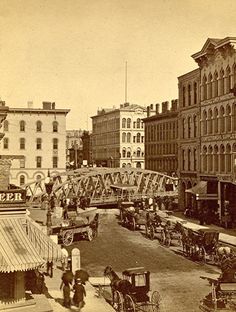
The pictures here show the kind of work he did rather than representing any specific construction of his.


