
Son of William O’Donnell, he was born in 1844 and age two when his parents emigrated.
Life
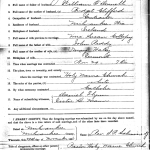
He married, first, Bridget Quinn on May 6, 1869 (below), when he was 24 and she, 19. Their ten children are listed in the entry on Bridget. They lived in the O’Donnell Flats (pictured below) at 1326 Clybourn St. in the heavily Irish Fourth Ward.
Bridget died quite young, 34, just a few weeks after the the death of her newborn son in 1884, who lived a scant five days. The eight children who survived and their many descendants form the numerous branches of the O’Donnell family tree in Milwaukee.
He next married Susan Reddy Collopy in 1888 (below), who brought three Collopy children to the family. They then had two children together: George (1889-1971), who became a veterinary surgeon (his biography is sketched in his mother’s profile) and Frances (1891-1898).
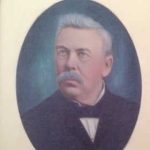
These first two items are–possibly–portraits of James J. O’Donnell and Susan Reddy Collopy. They were identified by another researcher but the source wasn’t provided so there’s no way of knowing if these are in fact the right individuals.




Work and Death
James joined his father in street and sewer construction, his efforts enlarging an already successful business (Bruce, History of Milwaukee City and County). He died suddenly and early, at 62, in Bainbridge, Georgia, just north of the Georgia-Florida border, where he had gone to bid on a large sewer construction project with oldest son, William.


The Milwaukee Sentinel and the Atlanta Constitution (further down) reported that he died of heart failure while at dinner in the Bon Air Hotel on November 8, 1906. Some further information about the family and the business can be read below in Bruce’s sketch of Edward O’Donnell, the fourth child of James and Bridget and seemingly the prime mover behind the family business after his father’s death.
The success of the family business can be measured by the size of the project they were ready to undertake in Georgia. The company’s bid of $32,537 for the nine mile pipe is equivalent to over a million dollars today. Unfortunately, it was the second lowest bid, just $1200 over the winning proposal, and the contract was awarded elsewhere (Engineering World, November 23, 1906). A devastating loss for the family and a disappointing one for the business.
The extensive coverage of his death bears witness to the prominence of the family business. The Sentinel obituary credits him as one of the four major contractors responsible for laying out much of Milwaukee’s street and sewer infrastructure during the city’s rapid growth in the late 19th century. He was an active figure in local politics as well.
An Unexpectedly Large Estate
Finalizing his estate took four years and 330 pages of inventories, supplemental inventories, petitions, lists, applications, orders, and administrative paperwork.
What was completely unexpected was discovering James to be a real estate investor of some magnitude. His properties numbered between 15 and 20, possibly 25.
Whatever the number, this snapshot of his financial life shows an ambitious, successful person who exemplified the American immigrant story: start small, grow, work hard, be smart. James did it all well. The results speak loudly:
- His estate was settled as $81,976, equivalent to $2,881,000 today. Of that amount,
- Real estate holdings amounted to $64,122 ($2,253,000), and
- Personal property valued at $13,685 ($481,000).
In the final distribution Susan received $7,105 ($250,000) as well as having received during the probate process a maintenance allowance $125 a month ($4,200) . The share of each of the nine children was $3,888 ($137,700).
Neither of Susan’s two surviving Collopy children received a share, although James’ son with Susan, George, did.
Despite the extensive time in probate, the family seems to have avoided the infighting and bitterness that often accompany an estate disposition. Case in point: the will of Eugenie Kortsch.
The Man
James appears to have possessed an outsized personality. In the fourth item below, a long-time acquaintance describes him as having a “rough exterior” but being “tender and sympathetic,” as well as “upright . . . honest and absolutely incorruptible.”


Encounters With The Police
His rough exterior more than his tenderness was on display in his two publicized run ins with the law, the most serious an 1882 brawl in which he sliced off part of an employee’s nose with a shovel, leading to a charge of assault with intent to commit murder. He argued in court that he was only defending himself after being threatened–also with a shovel–by the employee. The trial disposition of this duel by shovel found him guilty of assault without intent to kill and he was ordered to pay $5,000 in damages. That would be a considerable $136,000 today.
Before judging him too severely we may want to make some allowance for what he was going through at the time: the fight occurred just a few weeks after the death of his tenth child and when Bridget was gravely ill before her own early death.
The second criminal case occurred two years earlier, in Mom’s genteel Bay View no less, and involved a cross-accusation of theft of a watch and clothing worth $85 ($2300). The trial disposition isn’t known.
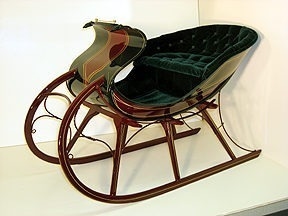

And while it wasn’t a criminal complaint, he had a later brush with the law in the winter of 1890 when his cutter overturned while crossing the trolley tracks at Second and Wells. He was taken to the police station where his injuries were treated. It’s easy to think alcohol might have been involved (12 children, remember, by this time, with another on the way), but it may only have been a case of a skittish horse or distracted driving on an unplowed street. (A cutter, designed for two to four people, was notoriously prone to tip over when turning, while a sleigh, seating six to eight, had wider-spaced runners and greater stability.)
This biographical sketch of Edward O’Donnell, James’ third son and fourth child, offers some information about James, the family, and the successful business he and his sons ran.
EDWARD J. O’DONNELL For three generations the O’Donnell family has been engaged in street and sewerage, contracting in Milwaukee, the family name standing as a synonym for expert work and thorough reliability in this connection. Edward J. O’Donnell, now carrying on the business, was born in this city October 10, 1875, and is a son of James O’Donnell, who was born in Ireland in March, 1844. He came to Milwaukee with his parents in 1850, his father, William O’Donnell, becoming a prominent builder of streets and sewers in this city. James O’Donnell acquired his education in the public schools here and later he, too, took up contract work in street and sewer construction and grading. He was the first to take contracts for grading in this city and he followed this line of business throughout his entire life, becoming very prominent in that connection. He was also a recognized leader in democratic ranks in Milwaukee and labored untiringly for the success of the party but did not seek public office. However, he was awarded the garbage contract for the city during the first administration of Mayor Rose and served under Dr. Kempster as health commissioner. At one time he was in partnership with John J. Crilley and in association with such men as Mr. Crilley, James Markey and R. J. Hickey he did much of the street and sewer work in Milwaukee for many years. He died very suddenly in Bainbridge, Georgia, on the 8th of November, 1906, having gone to that city to see about a contract, and his death was a great shock to the community, many warm friends greatly lamenting his untimely taking off. His son, Edward J. O’Donnell, acquired his education in the parish school connected with the Holy Name Cathedral and in Marquette University, after which he joined his father in the contracting business and was associated with him to the time of the father’s death. Soon afterward, in 1906, the sons organized a company known as the O’Donnell Brothers Company, general contractors. They have laid more water mains than any other firm in Milwaukee. In 1919 Edward J. O’Donnell, withdrawing from the firm, established a general contracting and construction business on his own account. In 1909 the O’Donnell Brothers Company laid a thirty-six inch line feeder main from the water tower on North Avenue through the eighteenth ward, seventh ward and first and third wards, being the largest main laid up to that time. The principal contracts of the O’Donnell Brothers Company have been in the line of sewer and water work, and Edward J. O’Donnell was associated with the firm while many mammoth contracts of this character were executed. Some of the excavating contracts done by the firm were the St. Mary’s hospital, Bay View public library; Engineering building of Marquette University and others, also the sewer and water works system of the Agricultural schools for Milwaukee county at Wauwatosa, Wisconsin. Edward J. O’Donnell is now doing work of similar character under his own name and is fully sustaining the high reputation that has always been borne by the family as contractors in this city. In 1908 Edward J. O’Donnell was married to Miss Ella Lloyd, a daughter of Thomas Lloyd, who was in the express business at an early day in Milwaukee. They have become parents of six children: Edward, Ellen, Robert, Phillip, Lloyd and Mary Rose. Mr. O’Donnell has always held to the principles of the democratic party and has been a delegate to party conventions, but while working untiringly for the success of the organization, he has never aspired to office, preferring always to concentrate his efforts and energies upon his business affairs, which, wisely and carefully directed, have brought to him substantial success William George Bruce, History of Milwaukee, City and County, 3 vols., 1922; vol. 2, pp. 741-742 |
His Legacy
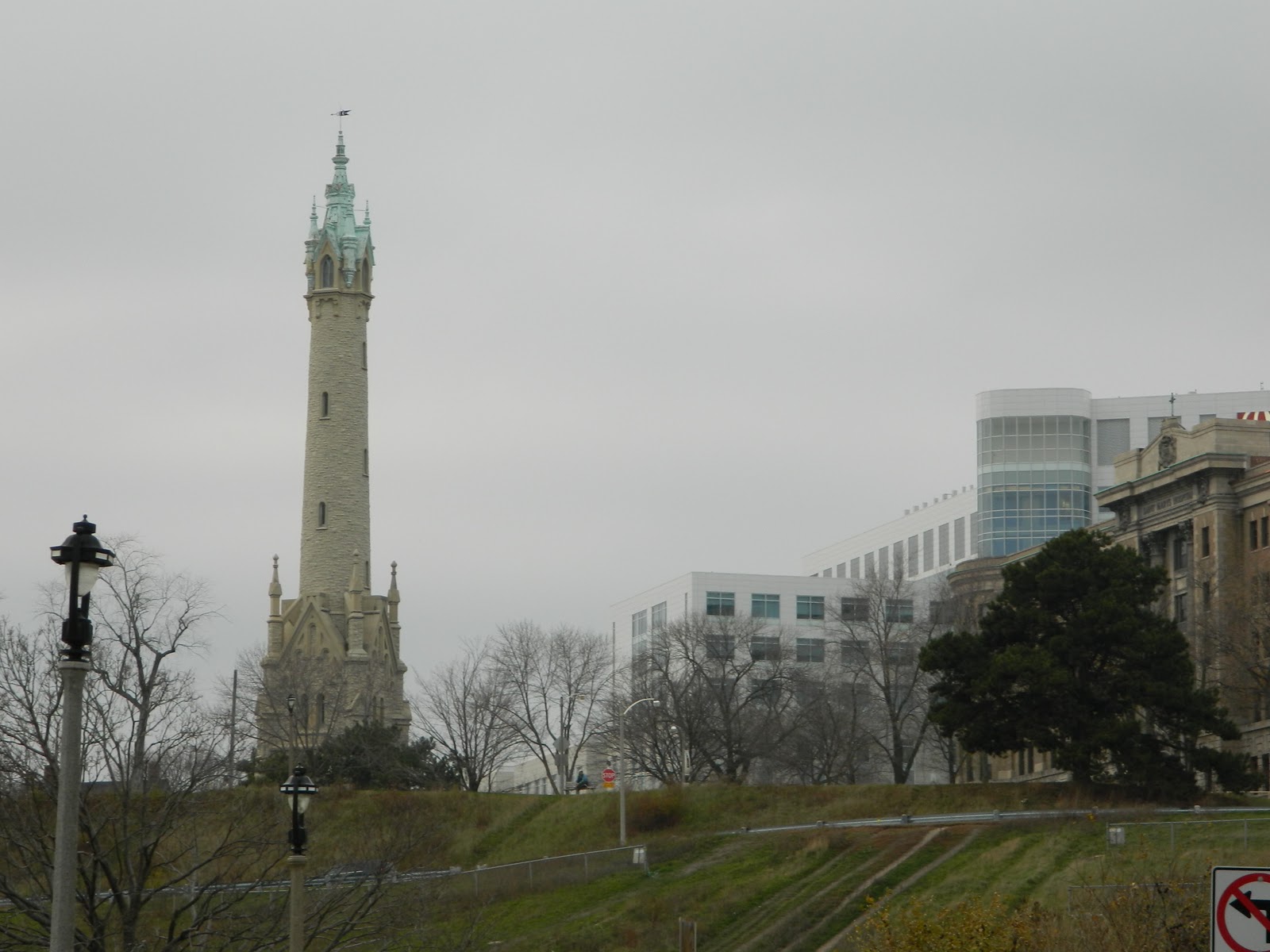
After his death his sons started the successful O’Donnell Brothers general contracting company in 1906. They laid more water lines in the city than any other company, especially in the area east of the river to the lake and from roughly North Avenue down to Juneau Avenue. As told by Bruce, the brothers laid the largest water main in the city at the time, a 36 inch pipe extending from the Water Tower next to St. Mary’s Hospital through four of the city’s east side wards, excavated the foundations of St. Mary’s Hospital (opened in 1909), the Bay View Public Library, and Marquette University’s engineering school, as well as the water and sewer systems for the county agricultural schools in Wauwatosa.

A towering memorial for James and Bridget Quinn O’Donnell was placed near their graves in Calvary Cemetery by their children. The cross on top is ornamented with the Greek letters iota, eta (‘Η’), and sigma superimposed over each other in monogram format, representing the first three letters of Jesus’ name in Greek. In a happily apt coincidence, the letters are also the first words of the O’Donnell family motto, “In hoc signo vinces,” a fitting emblem to mark the graves of the O’Donnells lying below it.
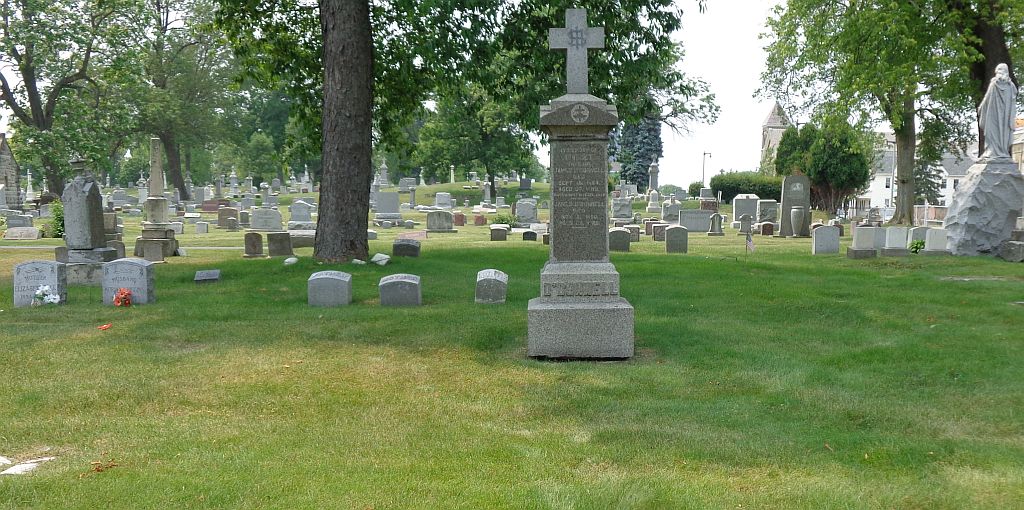
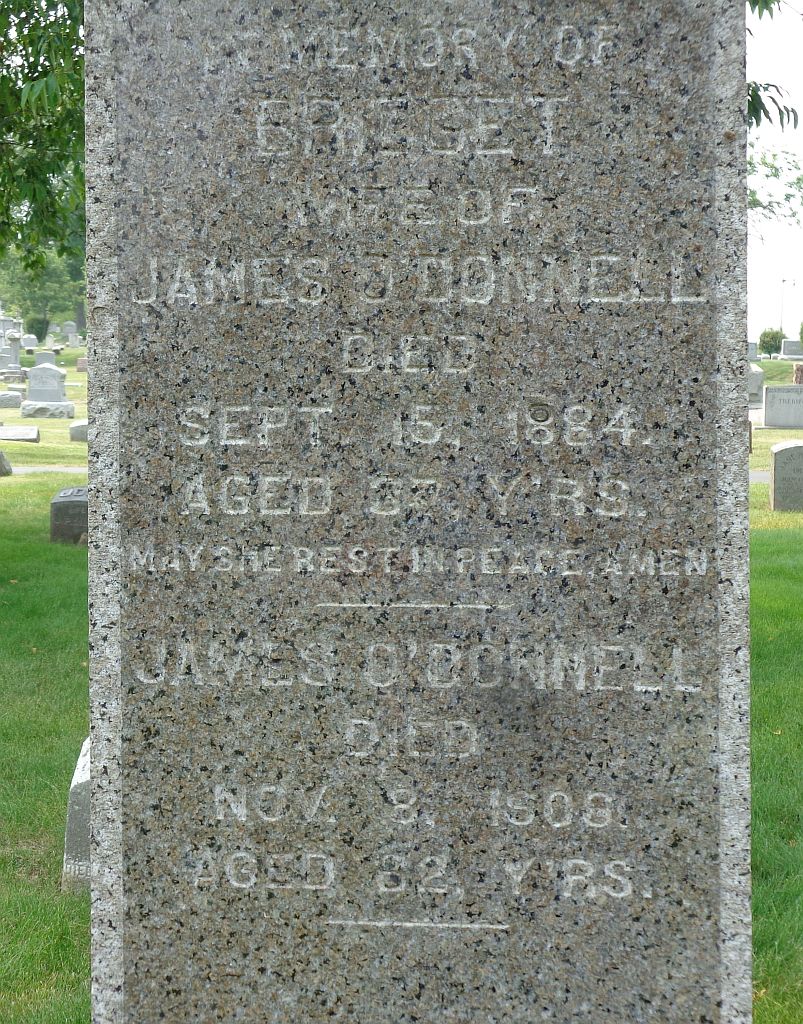


The inscription on the memorial’s plinth reads: “In Memory Of|Bridget|Wife of|James O’Donnell|Died Sept. 15, 1884|Aged 34 Y’rs.|May She Rest In Peace Amen|James O’Donnell|Died|Nov. 8, 1906|Aged 62 Y’rs.”
Their two headstones behind the memorial can be seen in Bridget’s post. The third is that of James’ second wife, Susan Reddy Collopy O’Donnell.