- Born September 7, 1918
- Graduated Gesu Grade School (1932)
- Graduated West Division High School (1933-1937)
- U.S. Navy, World War II, Dental Technician First Class, USS Effingham (1944-1945)
- Married Margaret M. Kortsch (1944)
- Graduated Marquette University, B.S., Business Administration (1947)
- Graduated Marquette University Law School (1949)
- Children: James, Kevin, Margaret, Paul, Mary Ellen, Norah, Ann
- Private Practice (1949-1951)
- Assistant District Attorney, City of Milwaukee (1951-1954)
- Deputy Milwaukee County Corporation Counsel (1954-1985)
- Retired 1985
- Worked Part Time at Kevin’s Subro Audit, Inc.
- Died 2010
Pictures of Dad appear throughout the archive. Besides the pictures here, his large picture collection contains more pictures of him in each of the life stages described below. Enter his name in the search bar for everything on him in the archive.
Childhood
Three pictures of Dad as a baby. Then one of him as a freshman in 1934 at West Division High School, with a watchful look on his face. The fifth is of Dad’s best friend, James O’Herrin, who died before he reached eighteen. The following picture shows the memorial tribute to him in the West Division Yearbook in the year he would have graduated.
Dad was manager of West Division’s football team in his junior and senior years and was awarded an athletic letter for his efforts (above).


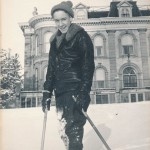


Young Adult
From the 1940 census we know Dad was working as a “wagon man” for a baker when he was 21, making $1400 in the previous year, or 70 cents an hour for a year’s full-time work. That’s equivalent to a little over $16 an hour today, or $32,300 annually, almost exactly the current federal poverty line for a family of four. Not much perhaps, but a substantial contribution to the family’s finances. He was, in fact, the primary earner in his family at the time; his father, by comparison, earned $868 ($20,000) the previous year as a clerk for the Works Project Administration.

The supplementary questions at the bottom of the page indicate that he was a truck driver for the bakery, an unexpected bit of information this because he didn’t know how to drive a stick shift until Mom taught him later in life.
It’s possible it was a horse-drawn truck, which might explain his fondness for horses, though staring at the back end of one for eight hours a day doesn’t seem the likeliest way to learn to appreciate them.
Something else striking in this census record is not only did the family have a boarder, Jean Kastelic, 21, the same age as Dad, but he worked as an office boy at a law firm. If we were to hazard a guess, Mr. Kastelic’s job may have put into Dad’s mind that he could get a similar position, something he accomplished not long after the census was taken when he was hired by Lines, Spooner, and Quarles. The firm was active from 1910 until at least 1960. Dad kept a history of the firm in his file cabinet.
In the 1940 typed letter below he asks that the firm not hire a replacement for a departing employee so he and friend Bill O’Herrin could expand their hours instead. It’s a cogent, well-reasoned argument, showing that he had quickly picked up how lawyers think.


The ‘Homer Trebilcox’ leaving the firm must be the same ‘Homer’ (1919-1983) who sent a breezy letter to Dad and Bill O’Herrin about life on board the USS Wyoming. The dreadnought (big gun) battleship was one of the oldest in the fleet, having been commissioned in 1912. It saw heavy action in the North Atlantic in World War I but by the 1930s was considered outdated and its service during World War II limited to being a busy gunnery training ship in the Chesapeake Bay.
Just before the war Dad applied to his draft board for a hardship deferment, citing his family’s need for his income. Two days after the Pearl Harbor attack, he wrote to cancel the request, saying he was ready to serve in any way possible.
What we’re seeing at this time in his life is Dad casting about for a professional occupation, the disastrous effect of the Depression on his family’s well being having indelibly impressed upon him just how financially precarious life could be without advanced education. After high school he worked at the bakery and probably other jobs while taking business school courses at Marquette. A little later, his work at the law firm prompted him to take evening pre-law classes at Marquette in 1940 with an eye to becoming a lawyer.


Also in 1940 Dad completed his draft registration (left). In it he lists himself as standing 5′ 11″ and weighing only 140 pounds, which was the reason he wasn’t accepted for enlistment until later in the war. After he made a determined effort to gain weight he managed to meet the Navy’s physical standards and was inducted.
World War II
To see Dad in the WWII years, tap on the links below. The letters Mom and Dad wrote to each other during that time are also below. (They’re also to be found in the top menu and sidebar.)


After his training and experience as a dental technician in the Navy, Dad returned home with a change of plan. He applied to Marquette’s dental school, thinking his background would allow him to proceed through the program quickly. After all, by this time he had a wife, a child, and Kevin on the way.

When the dental school wouldn’t accept his business credits, he returned to his original plan and took up a career in law. On the left is a letter he sent to Marquette’s registrar in August of 1945 asking about the transferability of his business credits to the law school. The reply hasn’t been preserved, but it must have been a positive one.
Money was tight while Dad was in law school. Although he worked steadily while taking a full-time course load, a rapidly enlarging family must have stretched finances to the limit. The first two items below show that he tried to make a go of it without help but finally, two years after Kevin’s birth in 1946, decided to ask for a supplement to the G.I. Bill stipend he was receiving. A copy of the application–the original having been sent to whatever governmental agency handled these requests–wasn’t retained in his files.
Work And Family
Also included here are the physician and hospital bills for Sis’ birth in 1947 ($50 and $64.50 respectively). In today’s dollars, those would be $746 and $962. The $64.50 was for 5 1/2 days in the hospital, a neat illustration of medical expense inflation. Although the amounts are modest by today’s standards they must have been a sizable outlay on a student’s budget, especially one with two children already.
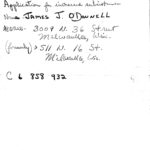
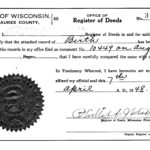


The family at this time was living with Grandpa O’Donnell, but with the arrival of Sis the arrangement must have been increasingly untenable, so Dad, despite being a full-time law student and working part time, stretched himself even further by providing a home of their own for his family. He found a small one at 3009 N. 36th St. by means of a partition sale, which probably indicates it sold for less than it might have through a conventional transaction. A partition sale occurs when the owners can’t amicably agree how to sell a property. A court orders the property auctioned off, the proceeds then divided equally among the owners. What Dad paid isn’t known but the property taxes in 1947 were only $204 ($3,024 today). The family moved into its new home in late spring or early summer, 1948.
After graduation in 1949, he opened a one-man firm, approximately 1949-1951, but the needs of a large family, by then five children, required a more stable income, so in 1951 he joined the Milwaukee District Attorney’s office as an assistant D.A. He found criminal legal work distasteful and three years later moved to the county’s Corporation Counsel for the rest of his career, retiring as Deputy Corporation Counsel in 1985.
When the then-Corporation Counsel retired in 1979 Dad was widely considered to be the most qualified person to become head of the office and was nominated to fill the position. He declined to be considered, however, worried it would be perceived as nepotism by voters and jeopardize his brother Bill’s political career as County Supervisor. Bill formally opposed his nomination for the same reason.
The next several pictures show that Dad acted briefly as a part time salesman of law books to supplement his income during the time he was in private practice. His address listed on the first item is St. Paul, MN, the location of West Publishing Company. The handwritten message on the brochure’s cover asking if he had cleared this activity with Civil Service suggests it turned out not to be OK for an assistant D.A. and his sales career ended.
Also shown are three artifacts from Dad’s unsuccessful run for the Milwaukee School Board in 1951.


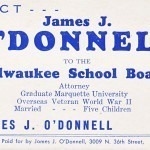
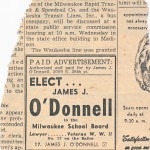

Below are an envelope from the law firm he worked at before the war and part time as a law student, his first Milwaukee Bar Association membership card (1949), an announcement of the opening of his law office (1949-1951), two pieces of stationery from that time, followed by two announcements of his appointment as assistant district attorney in 1951. His starting salary there was $527 a month ($6,656 today), or $6,324 yearly ($75,890).
Included also are his Corporation Counsel business card and a 1974 commendation letter for 25 years of service.
Retirement
Upon Dad’s retirement in 1985 the Journal ran two laudatory editorials praising Dad’s integrity and legal skill. Last are his post-retirement business card for the O’Donnell Law Office and a note of appreciation from one of the staff at Kevin’s Subro Audit when he retired from there in 1994.
His obituary is included, as is a picture of his grave marker (both below). Dad chose what was to be inscribed on the marker, so what he decided upon reveals what was important to him. Although he rarely talked about his war years, they made a profound impression on him. “PHM1, US Navy, World War II” is how he wanted to be remembered.